
The Quiet Strength of Coming Home: A Lived Experience of Home-Based Palliative Care
– Mr Hari Shankar Pothugunta, Bengaluru
A Mother’s World

Mornings in Pushpa’s modest home began with familiar rhythms, the quiet urgency of children getting ready for the day. Priya, her elder daughter, was studying Ayurveda. Kavya, the younger, was in her final year of pre-university. These sounds were the heartbeat of the house, a home that Pushpa, at 42, held together almost entirely on her own.
After her husband’s death, she became the sole breadwinner, stretching every rupee to educate her daughters and sustain the household. It was not an easy life. There were debts and the constant weight of responsibility. But there was also pride, in her daughters and in the life, she was building for them despite everything.
Then came the pain.
What began as a persistent discomfort was first dismissed, then endured, until it could no longer be ignored.
The Diagnosis That Changed Everything
The diagnosis was devastating: carcinoma of the rectum.
Pushpa underwent all available treatments, including surgery and chemotherapy, each offering a sliver of hope. But the disease progressed. Over time, curative intent gave way to symptom management. She returned home with a colostomy, a permanent and life-altering change that brought both practical challenges and emotional grief.
By the time the palliative home care team began visiting, the household had reached a breaking point.
Pushpa could barely eat. Persistent nausea and vomiting had stripped her of her appetite. Dysphagia made even swallowing water difficult. Loose stools, unrelenting fatigue, and uncontrolled pain confined her to bed.
The burden fell on her 70-year-old father, now her primary caregiver. Priya began missing college. Kavya would sit outside her mother’s room in the evenings, pretending to study, but always listening for signs of distress.
The suffering extended far beyond Pushpa’s body. It had entered every corner of the home.
The Team That Knocked on the Door
The first visit from the Kidwai-Saranam home care team did not feel like a clinical encounter. It felt like presence.
A doctor, a nurse, and a counsellor sat with the family and began with the simplest act, listening.
They assessed her symptoms, including pain, nausea, bowel issues, and colostomy care, but they also asked about her fears.
Pushpa, who had endured surgery and chemotherapy with quiet resilience, finally spoke.
“I’m not afraid of dying. I’m afraid of what happens to my daughters after.”
That moment shaped everything that followed.
Her pain regimen was optimized. For the first time in months, she woke without agony. Her nausea improved. Her bowel symptoms became manageable. Colostomy care was simplified into routines her father could confidently perform.
The nurse became a steady presence, addressing concerns, teaching care techniques, and helping her father move from fear to confidence in caregiving.
The counsellor began working gently with the family, creating space for conversations that had long been avoided. Plans were made for structured sessions with Pushpa, Priya, and Kavya, helping them express fears, process anticipatory grief, and speak about the future.
What Relief Looks Like
The prognosis has not changed. But something else has.
Pushpa still lives with advanced cancer. The uncertainty remains. Yet within that reality, there is now a sense of acceptance. Her pain is controlled. She can sit up, engage, and rest without distress. Her days have regained some rhythm.
Her daughters have returned, at least partially, to their studies. Not because the fear has disappeared, but because support has arrived.
The Saranam team continued to visit her home. Each visit is not only medical but also relational. A reminder that this family is seen, supported, and not alone.
The Value of Being Home
For Pushpa’s family, every hospital visits once meant disruption. Lost wages, missed classes, and emotional exhaustion. Palliative home care has changed that. Care now comes to her. The hospital is no longer the centre of her life.
This is the work of the Saranam multidisciplinary team. Not a miracle, but something steady and real. Care that meets patients where they are, attends to the whole person, and supports families through illness.
Coming Home
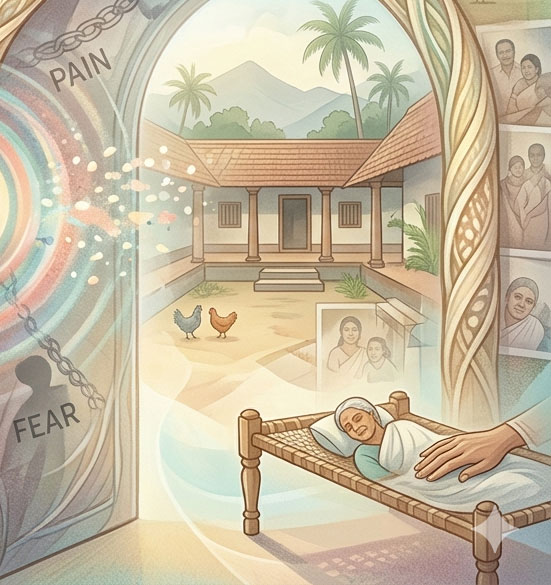
Pushpa’s story is not about cure. It is about relief. Relief from pain that once defined her mornings. Relief from hospital corridors that became her daughters’ second home. Relief from the silence that replaced laughter. Today, she rests at home, without pain. Her daughters study. Her father cares for her with confidence and love. The future remains uncertain, but they are no longer walking it alone. Pushpa’s story reflects what palliative care truly means. Not giving up, but choosing to live, and allowing those we love to live too.
Clinician’s Reflection
As clinicians, we are often trained to measure success in terms of cure, response rates, and survival. Yet, in homes like Pushpa’s, the meaning of care shifts. It becomes quieter, more deliberate, and deeply human.
This journey reminds us that good care is not always about changing the course of disease, but about changing the experience of living with it. In relieving pain, in restoring a sense of routine, and in supporting a family to stay connected through uncertainty, we witness a different kind of outcome.
One that cannot be captured in numbers, but is felt in the dignity of a patient resting at home, and in the resilience of a family that continues to move forward together.
“Supported by Saranam Foundation: Compassion without boundaries.”
About the Author:

Hari Shankar Pothugunta currently works as the Nursing Lead & Supervisor at Saranam the sheltr Foundation (KIDWAI home based palliative care services), Bengaluru, Karnataka.